
Copperplate Paper Adhesive is a category of pressure-sensitive adhesive (PSA) label stock engineered specifically for smooth, calendered coated papers — commonly known as art paper or copperplate paper. Unlike uncoated substrates, copperplate paper possesses a mineral-coated surface (typically kaolin clay or calcium carbonate) that yields an extremely flat, high-gloss or semi-gloss face. This surface demands an adhesive system calibrated to bond without bleed-through, wrinkling, or delamination.
The construction of a finished copperplate adhesive label is a three-layer composite: the face stock (the coated paper surface you see and print on), the adhesive layer (a solvent-based, water-based, or hot-melt PSA), and the release liner (a silicone-treated backing that protects adhesion until application). Mastery of all three layers — and the interfaces between them — is what separates commodity label stock from a truly high-performance solution.
Modern copperplate label adhesives are predominantly acrylic-based pressure-sensitive systems. Acrylic PSAs are polymerized from combinations of soft monomers (e.g., 2-ethylhexyl acrylate) for tack and flexibility, and hard monomers (e.g., methyl methacrylate or acrylic acid) for cohesive strength and temperature resistance. The ratio of soft to hard monomer controls the fundamental performance balance: higher soft-monomer content raises initial tack but may reduce shear resistance; higher hard-monomer content delivers long-term hold at the cost of immediate grab.
Three core rheological properties define PSA performance:
| Property | Definition | Practical Effect | Ideal Range (Copperplate) |
|---|---|---|---|
| Tack | Immediate bond force on light contact | Determines how quickly a label "grabs" during high-speed dispensing | 10 – 20 N/25 mm (loop tack) |
| Peel Adhesion | Force required to remove at 90° or 180° | Controls permanence after application dwell | 8 – 18 N/25 mm @ 180° |
| Shear / Cohesion | Resistance to slow, sustained lateral stress | Prevents label creep, edge lift, or slide under load | > 5,000 min (static shear @ 1 kg) |
Because copperplate paper has very low surface energy relative to polyolefin films, adhesive formulators optimize for paper wetting rather than film anchoring. The mineral coating is porous at the micro-scale; the adhesive must wet into micro-pores to achieve mechanical interlocking alongside van der Waals forces — a dual-bond mechanism that gives copperplate PSA labels their characteristic strong, clean peel.
Zhejiang Guanhao offers two primary grades under the Copperplate Paper Adhesive family, each targeting a distinct market segment.
The High Quality Copperplate Paper Adhesive pairs a premium coated face stock with a high-performance, space-grade surface material offering exceptional color-carrying performance and precise overprint registration. This grade is specified for applications where fine-line printing, dense barcodes, or regulatory text must remain legible across the entire product lifecycle. Pharmaceutical labels, cosmetic packaging, and premium consumer-goods labeling are primary end uses.
Key differentiators of the high-quality grade include finer coating smoothness (Bekk smoothness > 800 s), higher brightness (≥ 90 ISO), and a tighter adhesive coat-weight tolerance (±0.5 g/m²), all of which translate to more consistent ink density and color gamut on both offset and digital presses.
The Ordinary Copperplate Paper Adhesive delivers reliable, cost-efficient labeling for high-volume applications where ultra-fine print resolution is secondary to throughput speed and economy. Logistics labels, general retail price tags, food-service stickers, and plain barcode runs benefit from this grade's favorable price-to-performance ratio while still maintaining the clean peel and adequate tack expected of a coated label material.
| Parameter | High-Quality Grade | Ordinary Grade |
|---|---|---|
| Face Stock Brightness (ISO) | ≥ 90 | 80 – 88 |
| Surface Smoothness (Bekk, s) | > 800 | 300 – 600 |
| Adhesive Type | Premium permanent acrylic | Standard permanent acrylic |
| Coat-Weight Tolerance | ±0.5 g/m² | ±1.0 g/m² |
| Print Compatibility | Offset, UV offset, digital, flexo | Inkjet, laser, flexo, thermal transfer |
| Primary Applications | Pharma, cosmetics, luxury goods | Logistics, retail, food service |
| Temperature Range | -20 °C to 80 °C | -10 °C to 70 °C |
| Acid-Free / Archival | Yes | Standard (confirm per batch) |
The consolidated specification table below covers both grades across all structural layers of the composite.
| Specification | Value / Description |
|---|---|
| Face Material | Premium white copperplate (coated art) paper |
| Face Basis Weight | 80 – 100 g/m² |
| Total Construction Thickness | 120 – 140 µm (approx.) |
| Adhesive Chemistry | Acrylic-based pressure-sensitive (permanent) |
| Adhesive Appearance | Transparent; colorless after cure |
| Adhesive Viscosity | Medium (1,500 – 3,000 mPa·s, Brookfield) |
| pH (adhesive layer) | 6.5 – 7.5 (neutral / acid-free) |
| Loop Tack | 10 – 20 N / 25 mm |
| 180° Peel Adhesion (stainless steel) | 8 – 18 N / 25 mm (after 24 h dwell) |
| Shear Resistance | > 5,000 min @ 1 kg / 25 × 25 mm |
| Initial Set Time | 1 – 3 minutes |
| Full Cure Time | 24 hours |
| Release Liner | White / yellow silicone-coated kraft or glassine |
| Release Force | 5 – 15 cN / 50 mm (silicone-coated liner) |
| Operating Temperature | -20 °C to 80 °C (high-quality grade) |
| Application Temperature (min.) | +5 °C |
| Format Options | A4 / A3 sheets; rolls (custom width & OD) |
| Storage Conditions | 15 – 25 °C, 40 – 60% RH, away from direct sunlight |
| Shelf Life (sealed roll/sheet) | 12 months from manufacture date |
One of the defining advantages of a well-formulated copperplate PSA is broad substrate compatibility. The acrylic adhesive system wets effectively onto both high- and medium-surface-energy substrates, making it suitable for an exceptionally wide range of label application surfaces.
| Substrate | Surface Energy | Compatibility | Notes |
|---|---|---|---|
| Glass (clear / amber) | High (~73 mN/m) | Excellent | Widely used for beverage & pharmaceutical bottles |
| Stainless Steel / Aluminium | High (~45 mN/m) | Excellent | Industrial & electronic enclosures |
| PET / PETG | Medium-high (44 mN/m) | Very Good | Water bottles, cosmetic containers |
| Coated / Lacquered Cardboard | Medium (~40 mN/m) | Very Good | Retail & luxury packaging boxes |
| HDPE / PP Containers | Low-medium (31 – 36 mN/m) | Good | May benefit from surface treatment on recycled grades |
| Kraft / Uncoated Paper | Variable | Good | Moisture can reduce peel; use moisture-barrier top-coat |
| Rubber / Silicone | Very Low (<25 mN/m) | Limited | Consult technical team; primer may be required |
Copperplate Paper Adhesive is deployed across a diverse industrial spectrum. The following sections outline the most demanding use cases and why each one benefits from the material's specific technical properties.
The pharmaceutical sector imposes some of the most stringent label requirements in any industry: regulatory text must remain legible throughout the product's shelf life, adhesion must not fail under cold-chain storage, and the label itself must not interact chemically with the container or its contents. Guanhao's Drug Labels solution leverages the high-quality copperplate grade's acid-free, neutral pH adhesive to ensure zero chemical migration into glass ampoules or polymer blister packs. The high-brightness face stock satisfies GS1 barcode contrast requirements without additional calibration.
High-throughput warehouse environments apply labels at rates exceeding 200 units per minute. Logistics Labels must exhibit outstanding dispensing performance — low, consistent release force — combined with instant tack to prevent label mis-registration at speed. The ordinary grade's balance of economy and reliable tack makes it the preferred specification for pallet labels, despatch notes, and barcode tracking tags across e-commerce and 3PL operations.
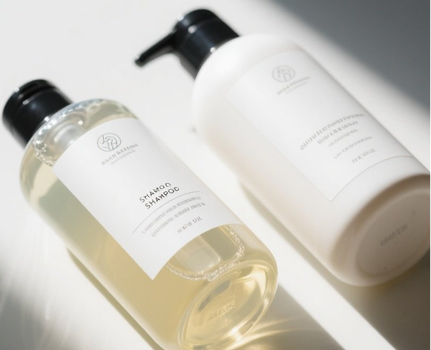
Labels on shampoo, skincare, and cleaning products must survive repeated exposure to moisture, oils, and surfactants. Guanhao's Daily Chemical label formulations pair the copperplate face stock with a moisture-resistant adhesive variant, delivering both aesthetic gloss (important for shelf appeal) and robustness in wet or humid environments.
Tire Labels face extreme mechanical stress — vibration, heat cycling, and contact with rubbers and release compounds on production lines. Here, the shear resistance of the acrylic adhesive system (> 5,000 min) is critical, preventing label creep during high-temperature curing processes.
Drinking Water Labels present a simultaneous challenge of wet-surface adhesion (condensation on cold bottles) and high aesthetic standards demanded by brand owners. The high-quality copperplate grade's fine smoothness enables precise four-color process print, while the acrylic adhesive maintains adequate peel values even when applied to chilled, slightly moist PET surfaces.
Retail Labels and Electronic Labels prioritize printability and scannability. Product barcodes and QR codes printed on copperplate paper consistently achieve ANSI/GS1 Grade A scan quality owing to the substrate's optical uniformity and the adhesive layer's prevention of ink feathering.
Office and light-commercial users requiring on-demand printing find A4 Flat Sheet Labels the most convenient format. The copperplate face accepts both inkjet and laser toner reliably, with the adhesive formulation tuned to prevent sheet curl in laser printers caused by fuser-unit heat.
Correct application procedure directly determines whether the label meets its rated performance specifications. The following guidelines apply across both manual and automated labeling environments.
| Step | Action | Technical Reason |
|---|---|---|
| 1 | Verify substrate is clean, dry, and free of oils or silicone contamination | Contaminants reduce adhesive wetting, lowering peel values by up to 40% |
| 2 | Condition materials to room temperature ≥ 30 min before use | Cold adhesives have higher viscosity and reduced initial tack |
| 3 | Apply label in a single smooth motion; press from center outward | Eliminates trapped air pockets that cause adhesive voids |
| 4 | Apply firm uniform pressure (≥ 20 N/cm²) for 2 – 3 seconds | Ensures full PSA contact with substrate micro-topography |
| 5 | Allow 24-hour full-cure dwell before exposing to stress, moisture, or temperature extremes | Adhesive flow and wetting continues post-application; premature stress reduces long-term hold |
| 6 | For automated lines, calibrate peel-angle to 45° – 90° off the liner | Minimizes release force variance, preventing label breakage on high-speed dispensers |
Label stock is a composite material: each layer ages at its own rate. The critical degradation mechanisms for copperplate PSA labels are adhesive oxidation (which reduces tack), moisture ingress into the face stock (which causes caliper gain and potential curl), and release liner aging (which increases release force over time). Following correct storage conditions mitigates all three mechanisms.
| Parameter | Recommended Range | Risk if Exceeded |
|---|---|---|
| Temperature | 15 – 25 °C | High temp: adhesive flow / blocking; Low temp: liner embrittlement |
| Relative Humidity | 40 – 60% RH | High RH: face-stock moisture curl; Low RH: static buildup, brittleness |
| Light Exposure | Away from UV / direct sunlight | UV degrades acrylic adhesive; face stock may yellow |
| Storage Orientation | Rolls: upright on core; Sheets: flat, in original packaging | Improper stacking causes core deformation and winding crease |
| Shelf Life (sealed) | 12 months from manufacture | Beyond 12 months: reduced tack; peel adhesion testing recommended |
Selecting between the High-Quality and Ordinary grades requires evaluating five decision dimensions:
| Decision Dimension | Choose High-Quality Grade if… | Choose Ordinary Grade if… |
|---|---|---|
| Print Resolution | Fine text ≤ 6 pt, micro-barcodes, or photographic imagery | Standard barcodes ≥ 0.25 mm module width, plain text |
| Regulatory / Compliance | GMP, FDA, EU Regulation 10/2011, or archival requirements | General commercial or logistics use |
| Temperature Exposure | Continuous -20 °C (frozen) or > 70 °C (autoclave-adjacent) | Ambient warehouse / retail environments |
| Chemical Exposure | Oils, surfactants, moisture, or aggressive solvents | Dry goods, paper-on-paper applications |
| Volume & Budget | Lower volume, premium positioning, brand equity is critical | High volume, cost efficiency is primary driver |
When in doubt, Guanhao's technical sales team can provide sample rolls for in-house testing and can review print-run data to recommend the optimal grade and format configuration. Visit the Contact page to request samples or a tailored quotation.